Friday, February 1, 2008

The Amillennialism of Athenogoras [A.D. 177]


Athenogoras was a Christian Apologist who defended the Trinity (while not yet called such), as well as the Doctrine of the Resurrection. He wrote an entire thesis on the resurrection and the final judgment, yet makes no mention of a millennium. Like most church fathers, Athenogoras has the resurrection of both the righteous and the wicked occurring at the same time, for the purpose of being judged.

“Now, if the righteous judgment awards to both together its retribution for the deeds wrought; and if it is not proper that either the soul alone should receive the wages of the deeds wrought in union with the body (for this of itself has no inclination to the faults which are committed in connection with the pleasure or food and culture of the body), or that the body alone should (for this of itself is incapable of distinguishing law and justice), but man, composed of these, is subjected to trial for each of the deeds wrought by him; and if reason does not find this happening either in this life (for the award according to merit finds no place in the present existence, since many atheists and persons who practise every iniquity and wickedness live on to the last, unvisited by calamity, whilst, on the contrary, those who have manifestly lived an exemplary life in respect of every Virtue, live in pain, in insult, in calumny and outrage, and suffering of all kinds) or after death (for both together no longer exist, the soul being separated from the body, and the body itself being resolved again into the materials out of which it was composed, and no longer retaining anything of its former structure or form, much less the remembrance of its actions): the result of all this is very plain to every one, — namely, that, in the language of the apostle, “this corruptible (and dissoluble) must put on incorruption,” (1 Corinthians 15:54) in order that those who were dead, having been made alive by the resurrection, and the parts that were separated and entirely dissolved having been again united, each one may, in accordance with justice, receive what he has done by the body, whether it be good or bad.” (Resurrection - Chap. XVIII. — Judgment Must Have Reference Both to Soul and Body: There Will Therefore Be a Resurrection.)

Like many church fathers, he is not clear on the timing of the Second Advent in relation to the above events. He could very well be postmillennial, though the lack of a millennium in his writing more than likely makes him amillennial.

Tuesday, January 8, 2008

The Amillennialism of Theophilus [A.D. 115-180]


The eschatology of Theophilus, bishop of Antioch, can be best gleaned from his writings concerning the resurrection and the final judgment (Apologia ad Autolycum). It is clear that he believed in one resurrection consisting of both believers and unbelievers.

“But you do not believe that the dead are raised. When the resurrection shall take place, then you will believe, whether you will or no; and your faith shall be reckoned for unbelief, unless you believe now. And why do you not believe? Do you not know that faith is the leading principle in all matters?” (To Autolycus. Book I, Chapter VIII, Faith Required in All Matters.)

Theophilus places the judgment directly after the resurrection, while making no mention of a millennium in between.

“Wherefore also, when man had been formed in this world, it is mystically written in Genesis, as if he had been twice placed in Paradise; so that the one was fulfilled when he was placed there, and the second will be fulfilled after the resurrection and judgment” (To Autolycus. Book II, Chap. XXVI. — God’s Goodness in Expelling Man from Paradise).

He goes to great efforts in his letter to defend the resurrection by using examples from the creation account, yet makes no mention of a millennium.

Friday, December 28, 2007

The Preterism of James the Just [A.D. 62]


In the Holy Writ, The Apostle James, the brother of Jesus, writing to “To the twelve tribes in the Dispersion” (James 1:1), warns them of the imminent coming of the Lord.

“Be patient, therefore, brothers, until the coming of the Lord. See how the farmer waits for the precious fruit of the earth, being patient about it, until it receives the early and the late rains. You also, be patient. Establish your hearts, for the coming of the Lord is at hand.” (James 5:7-8)

James tells his first century readers to “be patient” (vs. 7-8), “do not grumble” (v. 9), etc. The reason given is that “the coming of the Lord is at hand”.

The twelve tribes mentioned here could not have been the Jews of the 70 AD “Diaspora”, since James was martyred in A.D 62. Likely, this was a reference to Jewish Christians who had to flee Jerusalem, is the church of the First Century.

In addition, we have this extra-biblical account of the Martyrdom of James, given by Eusebius, where he proclaims that the Son of Man “is about to come upon the clouds of heaven.”

“On account of these words some believed that Jesus is the Christ. But the sects mentioned above did not believe either in a resurrection or in one's coming to give to every man according to his works. But as many as believed did so on account of James. Therefore when many even of the rulers believed, there was a commotion among the Jews and Scribes and Pharisees, who said that there was danger that the whole people would be looking for Jesus as the Christ. Coming therefore in a body to James they said, 'We entreat thee, restrain the people; for they are gone astray in regard to Jesus, as if he were the Christ. We entreat thee to persuade all that have come to the feast of the Passover concerning Jesus; for we all have confidence in thee. For we bear thee witness, as do all the people, that thou art just, and dost not respect persons. Do thou therefore persuade the multitude not to be led astray concerning Jesus. For the whole people, and all of us also, have confidence in thee. Stand therefore upon the pinnacle of the temple, that from that high position thou mayest be clearly seen, and that thy words may be readily heard by all the people. For all the tribes, with the Gentiles also, are come together on account of the Passover.' The aforesaid Scribes and Pharisees therefore placed James upon the pinnacle of the temple, and cried out to him and said: Thou just one, in whom we ought all to have: confidence, forasmuch as the people are led, astray after Jesus, the crucified one, declare to us, what is the gate of Jesus.' And he answered with a loud voice,' Why do ye ask me concerning Jesus, the Son of Man? He himself sitteth in heaven at the right hand of the great Power, and is about to come upon the clouds of heaven.'” (Eusebius' Ecclesiastical History - Chapter XXIII).

Certainly, no one among James’ listeners would have expected Christ’s coming “upon the clouds of heaven” to have been a distant future event. Any objective reader would have to conclude that James was a Preterist.

Monday, December 10, 2007

Silent Night on the Western Front

Herbert Otto Winckelmann tells of his father's experience in World War I.

“The war began on August 1, 1914. The order to mobilize the troops disrupted our vacation on the Baltic Sea. We rushed home since my father, an officer in the reserve, was eager to wear his uniform. He, along with most of the men, went into battle with enthusiasm. They were firmly convinced that war had been forced upon Germany, and that the fight was for the country’s very existence.

Father returned home on furlough before his artillery regiment departed to the front and optimistically promised to be home at Christmas. After mother pinned a small bouquet on his tunic, he kissed us heartily and left. He departed alone to avoid any more heartbreaking good-byes at the train station.

During the first months, it appeared that my father’s promise of a family Christmas would be realized. The Russian armies had been decisively beaten on the eastern front in the battles of Tannenberg and Masuran Lakes. On the western front, our armies advanced deep into France but were checked on the river Marne. As winter approached, both sides went into the trenches. They were sometimes so close to each other that they could hear the clatter of their foes canteens.

The stalemate had its effect on the spirit of the combatants. The initial enthusiasm gave way to stoicism. At Christmas, there was a momentary growth of spirit and some fraternization on the front lines. When the night became quiet on Christmas Eve, some German soldiers began to sing Stille Nacht (Silent Night). The English soldiers recognized the familiar tune and joined in. Their singing quickly traveled for miles along the trench lines and ragged Christmas trees were set up by German soldiers on their parapets. The following morning the English answered with large signs of “Merry Christmas”. It went even further. One by one the men ventured from their trenches and crawled beneath the barbed wires to meet each other in the no-man’s land. They sat together like brothers. They did not hate each other as their governments did. They had been ordered to kill one another. Unfortunately, the soldiers’ truce could not last. The higher echelons on each side, shocked by the incident, ordered their men back into the trenches.”


Jahresringe: A Journey of my Life, Herbert Otto Winckelmann, pp. 13-14

Wednesday, December 5, 2007

Saint Nicholas: Bishop of Myra


Yes, there was a Santa Claus, though it is difficult to separate the facts from the legends.

Mostly recognized as the patron saint of children and sailors in the Eastern Orthodox Church, Nicholas of Myra was born in the village of Patara (Asia Minor) in the third century to a Christian family. Apparently, an epidemic of some sort afflicted his family and left him as an orphan.

Nicholas became the bishop of Myra during a time of persecution under Emperor Diocletian. According to some sources, Nicholas was indeed a “secret giver”, and there is historical merit to some of the legendary stories about his giving. In one story, a wealthy man with three daughters fell on hard times, and was unable to provide a dowry for his children. Since girls without dowries back then were unlikely to marry, the man’s daughters faced the prospect of being sold into slavery. It is said in one account that each daughter was given a bag of gold in her stocking. Nicholas was known for giving to poor children, rescuing some drowning sailors, appealing to the emperor for tax relief, and intervening on behalf of those who were accused unjustly.

He also appeared to be a great defender of the faith, having destroyed the pagan Temple of Artemis, and fighting Arianism as a participant in the Council of Nicea.

An interesting looking movie about the life of Nicholas of Myra is set for release for Christmas in 2008. See trailer:

Friday, November 16, 2007

Thanksgiving: A Christian Holiday Part III

General Thanksgiving
By the PRESIDENT of the United States Of America
A PROCLAMATION

WHEREAS it is the duty of all nations to acknowledge the providence of Almighty God, to obey His will, to be grateful for His benefits, and humbly to implore His protection and favor; and Whereas both Houses of Congress have, by their joint committee, requested me "to recommend to the people of the United States a DAY OF PUBLICK THANKSGIVING and PRAYER, to be observed by acknowledging with grateful hearts the many and signal favors of Almighty God, especially by affording them an opportunity peaceably to establish a form of government for their safety and happiness:"

NOW THEREFORE, I do recommend and assign THURSDAY, the TWENTY-SIXTH DAY of NOVEMBER next, to be devoted by the people of these States to the service of that great and glorious Being who is the beneficent author of all the good that was, that is, or that will be; that we may then all unite in rendering unto Him our sincere and humble thanks for His kind care and protection of the people of this country previous to their becoming a nation; for the signal and manifold mercies and the favorable interpositions of His providence in the course and conclusion of the late war; for the great degree of tranquility, union, and plenty which we have since enjoyed;-- for the peaceable and rational manner in which we have been enable to establish Constitutions of government for our safety and happiness, and particularly the national one now lately instituted;-- for the civil and religious liberty with which we are blessed, and the means we have of acquiring and diffusing useful knowledge;-- and, in general, for all the great and various favors which He has been pleased to confer upon us.

And also, that we may then unite in most humbly offering our prayers and supplications to the great Lord and Ruler of Nations and beseech Him to pardon our national and other transgressions;-- to enable us all, whether in public or private stations, to perform our several and relative duties properly and punctually; to render our National Government a blessing to all the people by constantly being a Government of wise, just, and constitutional laws, discreetly and faithfully executed and obeyed; to protect and guide all sovereigns and nations (especially such as have shown kindness unto us); and to bless them with good governments, peace, and concord; to promote the knowledge and practice of true religion and virtue, and the increase of science among them and us; and, generally to grant unto all mankind such a degree of temporal prosperity as he alone knows to be best.

GIVEN under my hand, at the city of New-York, the third day of October, in the year of our Lord, one thousand seven hundred and eighty-nine.

George Washington

Tuesday, November 13, 2007

Thanksgiving: A Christian Holiday Part II

“They [the pilgrims] brought with them familiar customs, among which were an autumn secular harvest celebration and a Puritan religious Thanksgiving holy day. As we shall see, these two events were totally separate and independent in their minds.” (James Baker, former Director of Research, Plimoth.org)

With all due respect to Mr. Baker’s research, the pilgrims did nothing in the light of secularism. Their lives were Biblically oriented in all area, including harvest festivals. With the Church of England outlawed the many Separatist movements in the motherland, a group of Pilgrims began to hold secret meetings in Scrooby, England. To escape persecution, the group, under Rev. John Robinson, moved to Holland, and then decided to make the voyage across the Atlantic to the New World. Cotton Mather writes, “It was resolved, that part of the Church should go [to America] before their brethren, to prepare a place for the rest; and whereas the minor part of the younger and stronger men were to go first, the Pastor was to stay with the major, till they should see cause to follow.” (Cotton Mather, Magnalia Christii Americana)

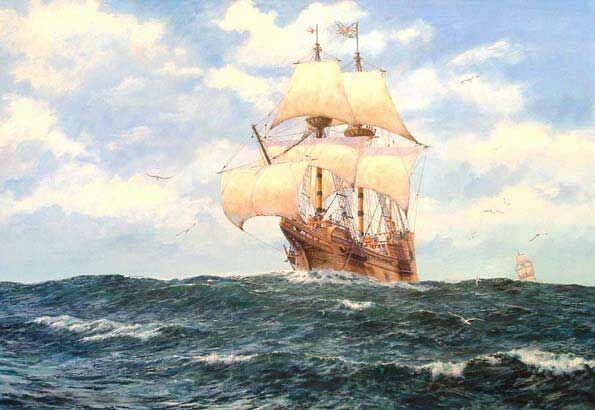
The harsh and dangerous voyage and resulting settlement would prove costly. 102 persons set sail on the Mayflower, with two dying during the trip, and one baby being born. They landed at Plymouth Rock on December 11, 1620. 45 more died during the first winter from diseases and harsh conditions, including the wife of future governor William Bradford. Bradford explained the purpose of this journey.

“A great hope and inward zeal they had of laying some good foundation, or at least to make some way thereunto, for the propagating and advancing the gospel of the kingdom of Christ in those remote parts of the world; yea, though they should be but even as stepping-stones unto others for the performing of so great a work.” (William Bradford, Of Plymouth Plantation).

Survival in the New World would require different skills (and different crops), and thus a Patuxet Indian by the name of Squanto decided to live with the Pilgrims and teach them how to survive. Bradford wrote that Squanto was a “special instrument sent by God for their good beyond their expectations." The resulting harvest in 1621 was plenteous, and the settlers began to regain their health. Bradford writes,

"They began now to gather in the small harvest they had, and to fit up their houses and dwellings against winter, being all well recovered in health and strength and had all things in good plenty. For as some were thus employed in affairs abroad, others were exercised in fishing, about cod and bass and other fish, of which they took good store, of which every family had their portion. All the summer there was no want; and now began to come in store of fowl, as winter approached, of which this place did abound when they came first (but afterward decreased by degrees). And besides waterfowl there was great store of wild turkeys, of which they took many, besides venison, etc. Besides, they had about a peck of meal a week to a person, or now since harvest, Indian corn to that proportion. Which made many afterwards write so largely of their plenty here to their friends in England, which were not feigned but true reports." (William Bradford, Of Plymouth Plantation).

Despite the hardships, the pilgrims honored the Providence of God Almighty, on the First Harvest that is the precursor to our modern day Thanksgiving.

"our harvest being gotten in, our governor sent four men on fowling, that so we might after a special manner rejoice together, after we had gathered the fruits of our labors; they four in one day killed as much fowl, as with a little help beside, served the Company almost a week, at which time amongst other Recreations, we exercised our Arms, many of the Indians coming amongst us, and amongst the rest their greatest king Massasoit, with some ninety men, whom for three days we entertained and feasted, and they went out and killed five Deer, which they brought to the Plantation and bestowed on our Governor, and upon the Captain and others. And although it be not always so plentiful, as it was at this time with us, yet by the goodness of God, we are so far from want, that we often wish you partakers of our plenty." (Edward Winslow, Mourt's Relation)

Governor Bradford “set apart a day of Thanksgiving” during the harvest of 1623, after enduring a horrible drought.